
How to Value an Antique Family Bible: A Step-by-Step Collector’s Guide

Open an old family Bible and the first thing you notice is almost never the binding or the gilt — it’s the handwriting. Birthdays, marriages, and deaths recorded in handwriting across the flyleaf, some by hands two or three generations older than yours. A family Bible is not merely a book. It is a family ledger, and for that reason alone it carries a weight that no price tag can capture.
But if you’re reading this, you’ve probably asked the question I hear in my workshop more than any other: how much is an old family Bible worth? The honest answer is that most of them are worth more to the family that keeps them than to the market that buys them. And the distance between those two values — the sentimental one versus the market one — is exactly what this guide is about.
I’ve rebound, restored, and appraised many family Bibles over the years, from a worn 1796 Hemingway & Nuttall to a 1595 Geneva Breeches Bible. In this guide I’ll walk you through the same process I use at my bench, step by step, so that when you hold your own family Bible you’ll know exactly what to look for, what it means, and what it’s worth — and, just as important, when to appraise it and when to restore it before it’s too late.

What Determines the Value of an Antique Family Bible?
Before we get to numbers, a word on what “value” means in antique family Bible valuation. There are two different values at play and they almost never agree.
The sentimental value is what the book means to your family — and for a volume that holds your own ancestors’ names, it is effectively priceless. The market value is what a collector or a dealer would actually pay for that same book. Your job, and mine, is to understand both, and to act on the gap between them. (If you are weighing a rare Bible as an investment as much as a keepsake, my piece on the investment value of rare Bibles goes further.)
Age and Rarity
Here is the myth I need to clear up first: age alone is not the same as value. A 19th-century American family Bible — and millions of them were printed, bound, and sold across the country — is old, but it is not rare. It is the combination of a specific printer, a specific year, a particular edition, and the number of surviving copies that drives price, not the date on the spine.
Consider the difference. A typical 1840s family Bible with a gilt spine, generous margins, and a full register of births and deaths at the back — the kind you still see in homes all across the country — was produced in large numbers, and a great many survive. Its market value is modest, even in very good condition. Now compare it to a 1595 Geneva Breeches Bible printed by Christopher Barker, or a 1608 Geneva Bible printed by Robert Barker. Those are rare, historically landmark texts, and they command a very different price entirely. If you want to see where that history begins — from William Tyndale’s 1520s translations through the early printed English Bibles — my Illustrated Guide to Bible Printing History is the best place to start.
The lesson: don’t reach for a value based on the date. Reach for it based on what was printed, who printed it, and how many survive. My guide to Authentication Markers in Rare Bibles by Century walks through exactly how this plays out — and if you are assembling pieces rather than valuing a single family Bible, my guide to building a historically significant Bible collection is where the strategy goes.
Condition and Completeness
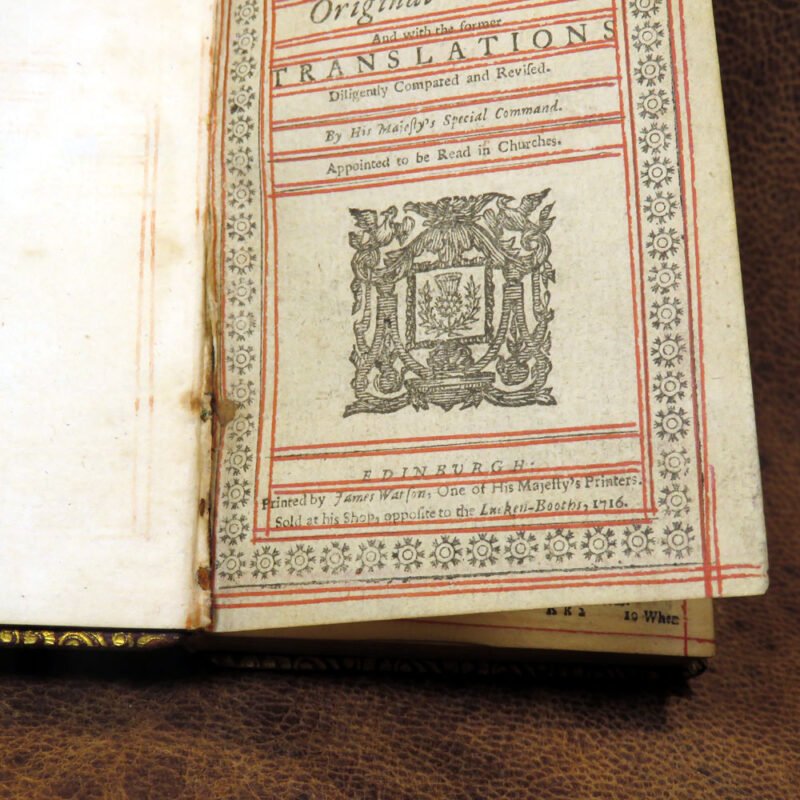
Of all the factors, condition has the largest swing on market value. Two Bibles of the same year and the same printer can differ in value by an order of magnitude depending on the state of their binding and their text block.
Here is what I check, and what I want you to check too:
- The binding. Is the leather cracked, flaking, or “mottling” (that fine orange powder that works off worn calf)? Do the joints hold or have they split? Has the spine been re-glued with a modern adhesive at some point?
- The text block. Are the pages tight or do they splay? Are the margins wide and clean or have they been cropped by a later owner? Look for water damage, foxing, or a trail of wormholes.
- Completeness. Are both title pages present? Are both testaments — and any Apocrypha — intact? And most importantly, is the family register still there or has a previous owner torn it out?
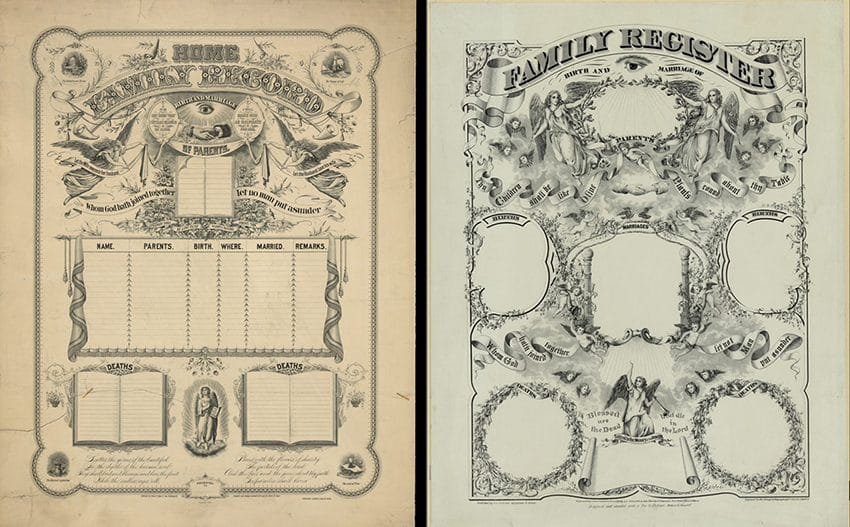
That register deserves a sentence of its own. It is the part of the Bible that carries its provenance — and it is the first thing a less scrupulous buyer is tempted to remove. If your register is loose, flaking, or at risk; that is a signal that a conservation-grade rebind is worth far more than its cost, because you are not just saving a book. You are saving a document.
Provenance and Unique History
Provenance is the least predictable — and often the most rewarding — factor in rare family Bible identification. It is the story a book tells about the people who owned it, and it is the factor most likely to turn a modest book into a remarkable one.
The things that raise a family Bible’s interest, and its value:
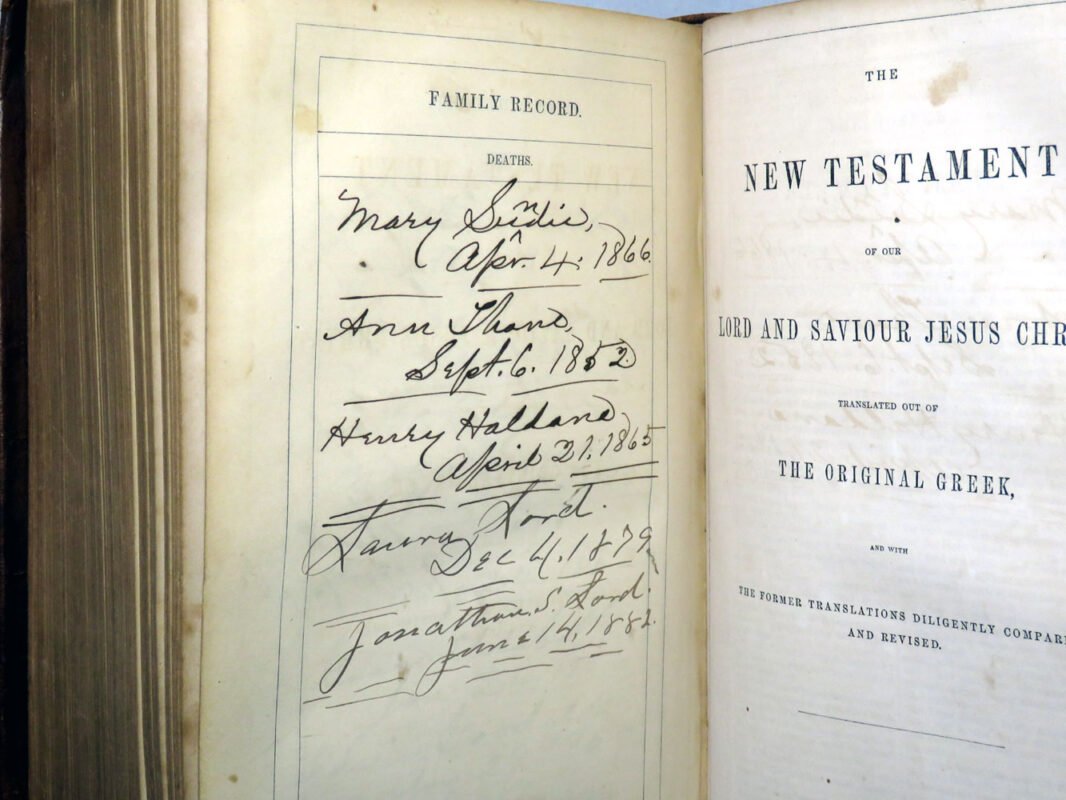
- Handwritten family records. Multiple generations of births, deaths, and marriages, and any personal notes in the margins. The more generations, and the more legible the hand, the better.
- A notable owner. A signature, bookplate, or inscription that ties the volume to a historical figure, a clergyman, or a well-known family.
- A unique historical note. A pressed flower, a dedication that ties the book to a specific event, or a marginal annotation that records something you will not find anywhere else.
Think of a family Bible whose register records a family’s genealogy, and its births and deaths, across decades. That page is not just a page — it is a primary historical document. Collectors and family historians pay a genuine premium for exactly that kind of provenance. It is the difference between a book and a document.
Step-by-Step Guide to Identifying Your Bible’s Edition
Now the practical part — how to identify old Bibles, specifically what edition you have and who printed it. This is the same sequence I use at my bench, and it is the practical companion to my longer piece on unlocking the pages of history: identifying and dating antique Bibles.
Step 1 — Read the title page, and the leaf behind it. The title page gives you the edition name, the printer or publisher, and often the place and date of printing. Turn it over: the verso very often carries the actual imprint — the name of the printer or the bookseller — which is the detail that separates a common edition from a rare one.
Step 2 — Examine the spine and the binding. The spine may carry a title, a date, or a printer’s device. The style of the tooling, the type of leather, and the structure of the binding — the sewn signatures, the pastedowns, the endpapers — all date the book and hint at its origin.
Step 3 — Look for a colophon or copyright page. On 19th- and 20th-century Bibles, the copyright or colophon page gives you the publisher, the year, and sometimes the edition or series. This is where names like “Hemingway & Nuttall” and “American Tract Society” show up.
Step 4 — Use the register to date the earliest entry. The oldest handwritten entry in the family register gives you a firm “not printed before” date. A register that begins in 1788 tells you the book is at least that old — and it dates your earliest provenance too.
Step 5 — Cross-reference, don’t guess. This is the step most people skip, and the one that matters most. Take what you have gathered — edition, printer, place, date, and the earliest register entry — and match it against a reference. My Printable Antique Bible Edition Reference Guide walks through the major editions, from the Great Bible through the King James Version, with the exact printer names and dates to look for. And if you want the deeper, century-by-century treatment, my Ultimate Guide to Identifying Antiquarian Bibles is the one I send most collectors — and for the story behind the King James Version that so many family Bibles carry, my profile of who was King James I is where I send collectors next.

When to Appraise vs. When to Restore
This is the part I care about most, and the part most valuation guides skip. Because for a family Bible, the question is rarely “should I sell it?” It is “how do I keep it from being lost?”
Get it appraised if:
- You want a real market value for insurance, an estate, or a potential sale.
- You are weighing whether to sell, and want to know if it is a collector-grade piece or a common one.
- You want a documented record of its condition and provenance before it deteriorates further.
Get it restored if:
- The binding is cracking, flaking, or mottling and the pages are at risk of falling out.
- The family register is loose, flaking, or at risk — because that is provenance and it cannot be replaced.
- The book is worth more to your family than to the market — in which case, restoration is not an expense, it is an act of preservation.
Here is the truth I tell every family I work with: a Bible with a cracked spine is a clock that is already ticking. The leather keeps deteriorating, the old adhesives keep failing, and one more harsh winter or summer in an attic or basement can turn “worn” into “gone.” If the book matters to your family — and if it holds your own names in the register, it almost certainly does — then the best way to preserve its value, in both the market sense and the human sense, is a structural restoration now, not a salvage after the damage is done.

That is exactly what my Antique Heirloom Renewal Package is built for: restoring old family Bibles the way they deserve — a conservation-grade, structural rebind that saves the binding, the text block, and the register, and keeps the book whole for the next generation. And if you would like to know what your specific Bible needs, you can get an instant rebind quote right here. Send me photos of the cover, the spine, the register, and the first page, and I will tell you honestly what it needs.
Because in the end, an old family Bible is worth two things: what the market will pay, and what your family will remember. The first you can find out in an afternoon. The second is only preserved if you act while you still can.